Sneak peek · 1 min read
How to automate your entire company — loops are C.W.L.
There are two ways to do this. One is to have an agent watch you and infer the pattern — learn the habits, guess the repetition. The other is to hand you the loop and let you say when. We chose the loop.
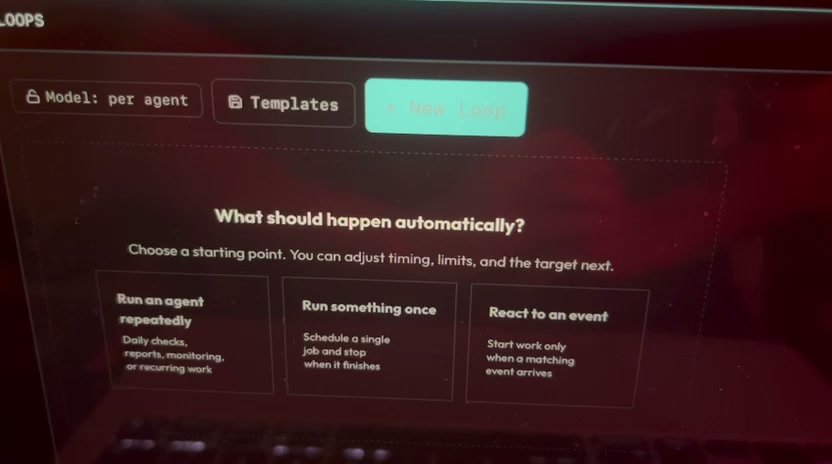
Run an agent repeatedly — daily checks, reports, monitoring. Run something once — a single job that stops when it finishes. Or react to an event — a webhook watching an endpoint, the same way the web has always worked.
The path is short. Prototype the prompt in the chat until it does the thing. Schedule it into a loop. The system then does the job repeatedly and you stop thinking about it. An email that has to go out every day at 7am is the case everybody names first — the most basic one, and it is always there.
Past that we cannot predict you. The needs are different in every business, and only the owner knows them. What we can do is be ready to provision the exact tool the moment yours shows up.
C.W.L. — chat, workflow, loop
An acronym invented on the spot, on camera, and worth keeping in your head. Chat is where you experiment. Workflow is where you connect it to the way your business actually runs. Loop is where you hand it over. An entry point, an exit point, and the same three letters every time — so you never feel lost inside the application.
Which makes automation a decision problem rather than a technical one. The Eisenhower matrix sorts what is urgent against what is important; C.W.L. is what you do with the quadrant you decided not to keep. Delegate it, loop it, move on — and go for the next task, which is usually automating one more thing.
Loops are periodic jobs with an agent inside — not a guarantee of full automation. But whatever the agent takes is time handed back. For human relationships. For eating. For breathing. And for the business you actually wanted to run.
Know your processes, and the loops will hold them.
Reserve seats for your organisation
Join the waitlistAntevisão · 1 min de leitura
Como automatizar a sua empresa inteira — loops são C.W.L.
Há duas maneiras de fazer isto. Uma é pôr um agente a observá-lo e a inferir o padrão — aprender os hábitos, adivinhar a repetição. A outra é dar-lhe o loop e deixá-lo dizer quando. Escolhemos o loop.
Correr um agente repetidamente — verificações diárias, relatórios, monitorização. Correr uma coisa uma só vez — um trabalho único que pára quando termina. Ou reagir a um evento — um webhook a vigiar um endpoint, como sempre se fez na web.
O caminho é curto. Prototipe o prompt na conversa até fazer aquilo que quer. Agende-o num loop. O sistema passa a fazer o trabalho repetidamente e deixa de pensar nisso. Um email que tem de sair todos os dias às 7h da manhã é o caso que toda a gente nomeia primeiro — o mais básico, e está sempre lá.
Daí para a frente não conseguimos prevê-lo. As necessidades são diferentes em cada negócio, e só o dono as conhece. O que podemos fazer é estar prontos para provisionar a ferramenta exacta no momento em que a sua aparecer.
C.W.L. — chat, workflow, loop
Um acrónimo inventado no momento, em frente à câmara, e que vale a pena guardar na cabeça. Chat é onde experimenta. Workflow é onde liga aquilo à forma como a sua empresa funciona de facto. Loop é onde o entrega. Um ponto de entrada, um ponto de saída, e as mesmas três letras de cada vez — para nunca se sentir perdido dentro da aplicação.
O que faz da automação um problema de decisão e não um problema técnico. A matriz de Eisenhower separa o urgente do importante; o C.W.L. é o que faz com o quadrante que decidiu não guardar. Delegar, pôr em loop, seguir em frente — e ir para a tarefa seguinte, que normalmente é automatizar mais uma coisa.
Os loops são trabalhos periódicos com um agente lá dentro — não são uma garantia de automação total. Mas tudo o que o agente leva é tempo devolvido. Para as relações humanas. Para comer. Para respirar. E para o negócio que realmente queria gerir.
Conheça os seus processos, e os loops seguram-nos.